
The Dividing Line will be LIVE at 3:00pm EDT
Road Trip Debate: Is the King James Version the Best English Translation of the Bible? Dr. James White vs Dr. Doug Levesque, First Baptist Church, Livingston, Louisiana, 04/04/25
Road Trip Dividing Line: Jeff Durbin and the Jewish Representative, then Jay Dyer on Abraham
Story Time with Uncle Jimmy: The Acts of Paul and Thecla
I Told You the Sacralists Were Coming, Didn’t I?
A Nation Divided, My Irrelevancy, the Finished Atonement
A Divided Nation Then Thoughts on Ecumenical Councils
Jay Dyer Implodes on the Playground; Yes, Joe, Bishop and Elder are the Same Office
All About Ignatius with Timothy Easley
Back from Arkansas, Heading to Louisiana, Two Debates in April, Debate Comments
Speaking Events
April 2025 | ||||||
|---|---|---|---|---|---|---|
| S | M | T | W | T | F | S |
1
|
2
|
3
|
4
|
5
| ||
6
|
7
|
8
|
9
|
10
|
11
|
12
|
13
|
14
|
15
|
16
|
17
|
18
|
19
|
20
|
21
|
22
|
23
|
24
|
25
|
26
|
27
|
28
|
29
|
30
| |||
1946: The Movie
David Gushee Reviewed and Refuted
James has asked me to compile the complete response to David Gushee’s ‘Reformation Project’ speech. Here you will find the three episodes in order compiling a full five hours of response. Here are the YouTube versions of the same programs:
Mega DL Continuing Response to Matthew Vines
I was only going to discuss Matthew Vine’s “Gay Christian” presentation for the first hour, but since we were in the middle of the biblical discussion, I went ahead and continued, so we did a full two hours on the subject, covering Genesis 19, Leviticus 18:22 and 20:13, and...
“Gay Christianity” Refuted!
The complete response to Matthew Vines is now available as a single program. Yes its five hours and nine minutes long, but the world needs to hear this message. Share it with your friends and relatives. We’ve titled it “Gay Christianity” Refuted.
Finally! We Concluded the Matthew Vines Response on Today’s Mega Dividing Line
Five hours, fifteen minutes. That is how long it took me to review the one hour, five minutes of Matthew Vines’ presentation in defense of “gay Christianity.” We will be posting, Lord willing, tomorrow, a file containing the entirety of the 5.25 hours of discussion of these key biblical...
David Gushee abandons a biblical view of homosexuality
Sorry for the very late posting! This program primarily focused upon the comments made by David Gushee in reference to his abandonment of a consistently biblical view of homosexuality, Matthew Vines’ Twitter comments demanding the celebration of homosexuality, and then (switching gears), Austin Fischer and Romans 9. Here is...
A Believing Response to Matthew Vines’ 40 Questions
Matthew Vines has posted a series of forty questions, found here. I have written up a fairly brief response. I hope it is helpful. Do you accept that sexual orientation is not a choice? The very question simplifies the topic to a ridiculous level, Matthew. The desires a human...
Ahmed Deedat
Refuting the Shallow Arguments of Zakir Naik
As most of you know, Zakir Naik is a wildly popular Islamic speaker in the mode of Ahmed Deedat. Unfortunately, Naik knows better than to debate those who can demonstrate his errors. Which is why he remains so popular, it seems! But he cannot hide his many falsehoods. David...
Zakir Naik Illustrates the Dual Face of Islam When in the Public Square
Very interesting contrast from Zakir Naik’s own mouth (again illustrating why Naik refuses to debate those who could expose his arguments).
Zakir Naik’s Claims on Muhammad in the Bible
Here is my third and final response to Zakir Naik’s appearance on The Deen Show. What I did was take my opening statement from my debate with Shabir Ally on this topic from London in November of last year, along with my comments on Deuteronomy 18:18 from the preceding...
Shabir Ally
Debate: Tawhid or Trinity: Is God One or Three Divine Persons? with Shabir Ally at Georgia Tech, Atlanta, Georgia 11/13/2019
On November 13, 2019, James White debated Shabir Ally at Georgia Tech in Atlanta, GA on the topic Tawhid or Trinity: Is God One or Three Divine Persons?
Response to Dr. Shabir Ally, Part IV (Conclusion)
I hurry to finish my response to the article published by Dr. Shabir Ally shortly after our debate at the University of Pretoria in South Africa in early October. This is the fourth, and thankfully, final portion of my response. Dr. Ally continued: James was clearly in a bind....
Debate: Did the Earliest Followers of Jesus Believe in His Deity? Shabir Ally at University of Pretoria, South Africa 10/8/2013
Islam
Mockery is not a Christian Virtue, then, the Carson/Huff Discussion
Last Road Trip DL for 2024 coming from Holbrook, Arizona this evening. Started off looking at Joel Webbon’s defense both of “anons” and using them to mock people “right off X,” naming Owen Strachan as an example. Then we discussed the encounter between Wes Huff, a Christian scholar and...
Mishnah, Talmud, and the Ugly Rise of Side-B Nazism in 2024
Didn’t pull any punches today, folks. When the Nazis come after you it is time to shoot straight in return. Took on some nasty players today, but had to provide background information on, for example, the origination of the Mishnah, Gemara, and Talmud, etc. Hopefully useful to everyone, and...
A Few Comments on the Lawson Issue, Then More Than an Hour in Response to Sam Costner
Couldn’t avoid a few brief comments on the Steve Lawson issue that came to light today at the start of the program. Then I read through an eleven tweet thread written by Samuel Costner back on 8/31 regarding the Crusaders and my supposedly abandoning the younger generation by refusing...
King James Onlyism
Road Trip DL from Jonesboro
Mainly covered the upcoming debates, how to properly encourage someone interested in pursuing apologetics, foundational issues, etc., and then talked a bit about Gavin Ortlund and his videos, and the recent discussion about the canon of Scripture, the Deuterocanonical books, etc. Not sure about when we will be able...
Road Trip #3: The Sad Situation with Steven Anderson, then, Ammon Hillman Reveals His True Intentions
After a few minutes of the inevitable talk about being on the road, going through a McDonald’s drive-thru looking for Donald Trump, and the current election situation, I commented on the Steven Anderson saga, and then spent the rest of the program talking about the claims Ammon Hillman made...
An Unusual Monday Morning Dividing Line
Covered a wide range today, from insanity in Germany, more and more studies showing the danger of the Covid jabs, the Biden Regime’s war on Christians, a few interesting graphics I’ve run across, to finally in the last half of the program, a brief video from Barth Ehrman showing...
Bible Transmission
Confucianism, Islam, and Christianity – One Point of Contrast
Qin Shi Huang (260 – 210 BC) is the most prominent of the Chinese emperors. He united China through conquest, began the Great Wall of China, and had the Terra Cotta warriors built. He’s significant to Confucianism – and especially the textual transmission of Confucius’ works – because toward...
Atheism
Mockery is not a Christian Virtue, then, the Carson/Huff Discussion
Last Road Trip DL for 2024 coming from Holbrook, Arizona this evening. Started off looking at Joel Webbon’s defense both of “anons” and using them to mock people “right off X,” naming Owen Strachan as an example. Then we discussed the encounter between Wes Huff, a Christian scholar and...
Road Trip #3: The Sad Situation with Steven Anderson, then, Ammon Hillman Reveals His True Intentions
After a few minutes of the inevitable talk about being on the road, going through a McDonald’s drive-thru looking for Donald Trump, and the current election situation, I commented on the Steven Anderson saga, and then spent the rest of the program talking about the claims Ammon Hillman made...
The Changing World of Mormonism, A Few Tweets, 90 Minutes
Spent most of the first hour dealing with the changing world of Mormonism in light of comments from the “Ward Radio Show” and the idea of “religious bigotry” in not accepting Mormonism and its plurality of Gods as a Christian church. Looked at a chart about global fertility rates...
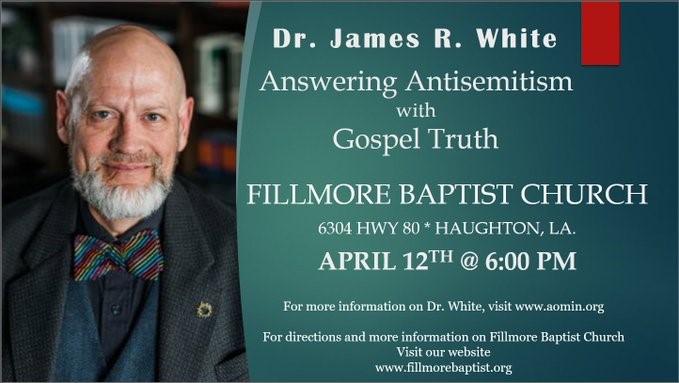
ANSWERING ANTI-SEMITISM
ReformCon25
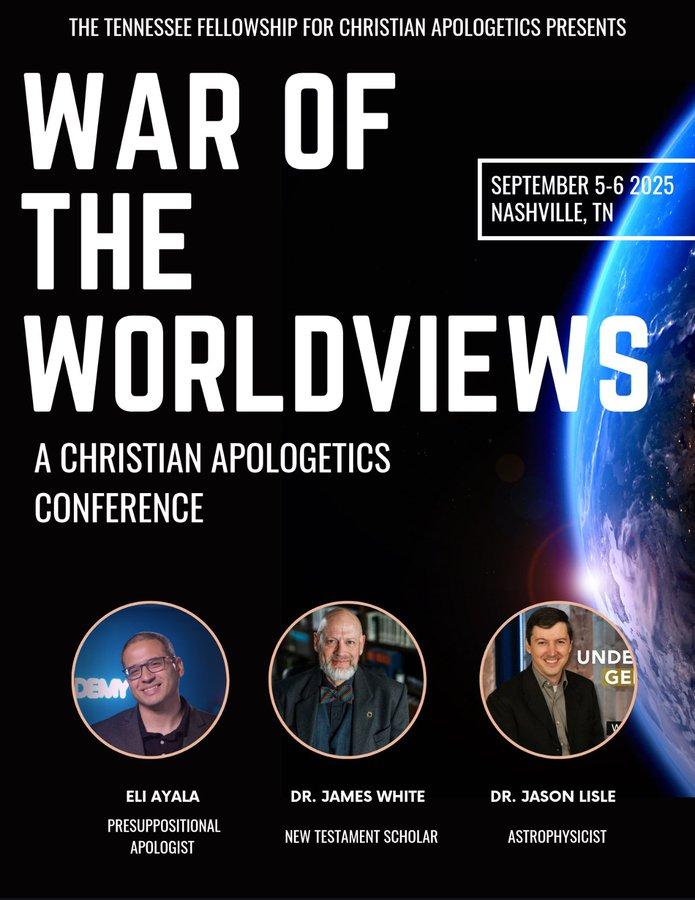
WAR OF THE WORLDVIEWS CONFERENCE
The Alpha & Omega Ministries App is now available to download.


The Dividing Line
The Dividing Line will be LIVE at 3:00pm EDT
The Dividing Line will be LIVE at 3:00pm EDT https://t.co/C3bklilrNP — Alpha and Omega Ministries (@AominOrg) April 9, 2025
Road Trip Debate: Is the King James Version the Best English Translation of the Bible? Dr. James White vs Dr. Doug Levesque, First Baptist Church, Livingston, Louisiana, 04/04/25
Road Trip Dividing Line: Jeff Durbin and the Jewish Representative, then Jay Dyer on Abraham
Rich worked hard to work on the audio challenges we have had in the past and the changes made it a lot easier for me to play video clips on the program today. So, we looked at Jeff Durbin’s exchange with the Jewish representative in Georgia, and responded to...
Story Time with Uncle Jimmy: The Acts of Paul and Thecla
As promised on today’s program I read through The Acts of Paul and Thecla, commented on the Orthodox veneration of Thecla as a saint and “equal of the Apostles,” and what we can learn about the context of the origination of this apocryphal mythology from the second century. By...
I Told You the Sacralists Were Coming, Didn’t I?
So Joel Webbon dropped a webcast about how the State is to correct the Church, and how this has been normative throughout church history. Well, do forgive me, but I’ve always opposed sacralism, still do, always will, and the errors and holes in the presentation, historically and logically, were...
A Nation Divided, My Irrelevancy, the Finished Atonement
Started off with more evidence of how divided a nation the US is, then moved on to listen to some brief comments from He Who Judges from Afar, and then we moved into some thoughts about the debate with Joe Heschmeyer, specifically on what his point was in emphasizing...
A Divided Nation Then Thoughts on Ecumenical Councils
Reflected on the deep division that exists in Western Culture today and in the United States in particular, and then moved on to some of the Jay Dyer stuff and the continued need to have an in-depth discussion on the “7th Ecumenical Council,” aka Nicea II.
Jay Dyer Implodes on the Playground; Yes, Joe, Bishop and Elder are the Same Office
About halfway through the program we had a power spike due to a storm blowing into Phoenix, but we got it all recorded anyway. First I dealt with the amazing explosion of infantile behavior by one Jay Dyer when I dared actually treat him like an adult in challenging...
All About Ignatius with Timothy Easley
Spent ninety minutes talking Ignatius, recensions, manuscripts, etc. with Timothy Easley today! Definitely a program for church history geeks! Hope all two dozen of you enjoy it!
Back from Arkansas, Heading to Louisiana, Two Debates in April, Debate Comments
Excited to be home, but excited to head out in just a matter of weeks for the “Louisiana Loop” that will take me to southern Louisiana for a debate on April 4th, and then to northern Louisiana for a debate on the 10th. Talked a bit about last weekend’s...
The Ignatian Strawman Extinguished
Though I really wasn’t feeling well after I arrived here in Amarillo, I felt it was absolutely necessary to address the amazingly dishonest attacks that have been launched against me about a single cross-examination question from Saturday night’s debate. So we did a full dive into Ignatius, his writings,...
Road Trip: Justification by Faith, Not Works, Twelve 5 Church, Jonesboro, Arkansas, 03/02/25
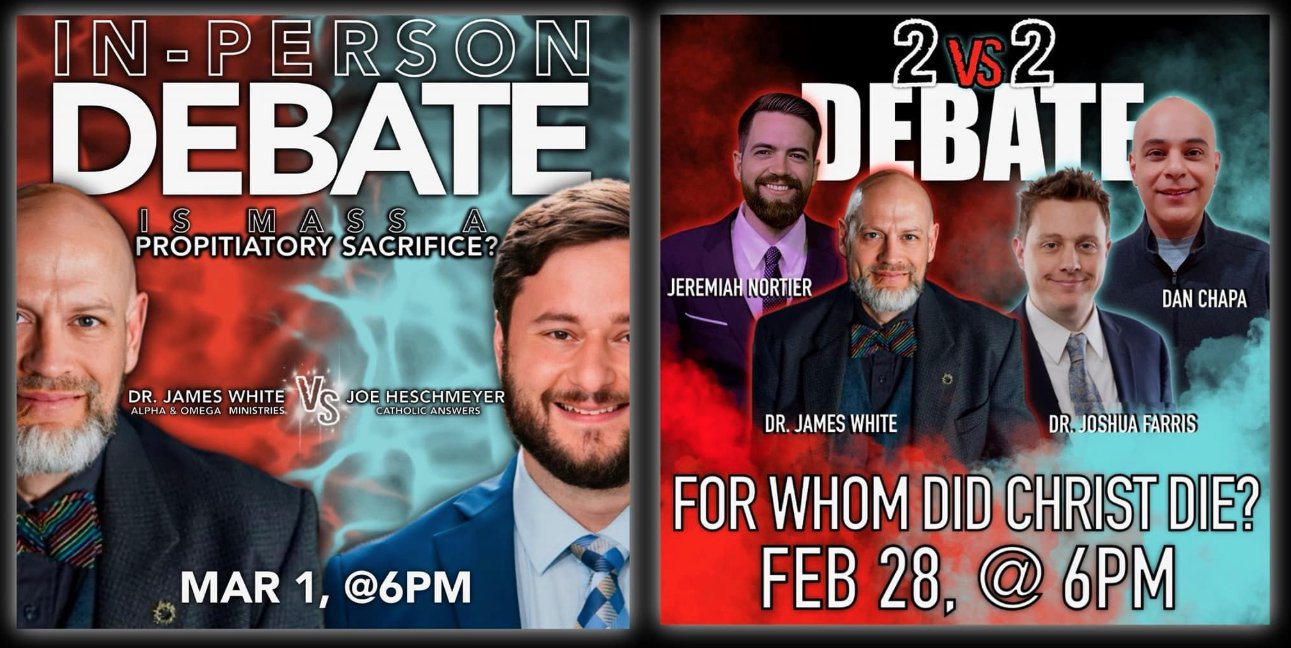
Road Trip Debate: Roman Catholic Mass Debate, Is Mass a Propitiatory Sacrifice? Dr. James White vs Joe Hershmeyer, Twelve 5 Church, Jonesboro, Arkansas, 03/01/25
Road Trip Debate: Limited Atonement Debate, For Whom Did Christ Die? Dr. James White & Jeremiah Nortier vs Dr. Joshua Farris & Dan Chapa, Twelve 5 Church, Jonesboro, Arkansas, 02/28/25
Road Trip DL from Jonesboro
Mainly covered the upcoming debates, how to properly encourage someone interested in pursuing apologetics, foundational issues, etc., and then talked a bit about Gavin Ortlund and his videos, and the recent discussion about the canon of Scripture, the Deuterocanonical books, etc. Not sure about when we will be able...
Road Trip DL: Conway; Francis, the Future, then Zeitoun as Evidence
Snuck a quick program in today before teaching at the seminary this evening, talking about developments with what seems like the soon passing of Pope Francis, etc. Then we briefly discussed recent conversations concerning Cameron Bertuzzi, a convert to Romanism, and his claim that the supposed appearances of Mary...
Road Trip: The False Gospel of Roman Catholicism – Part 2, Providence Baptist Church, Perryville, Arkansas, 02/23/25
Road Trip: The False Gospel of Roman Catholicism – Part 1, Providence Baptist Church, Perryville, Arkansas, 2/23/25
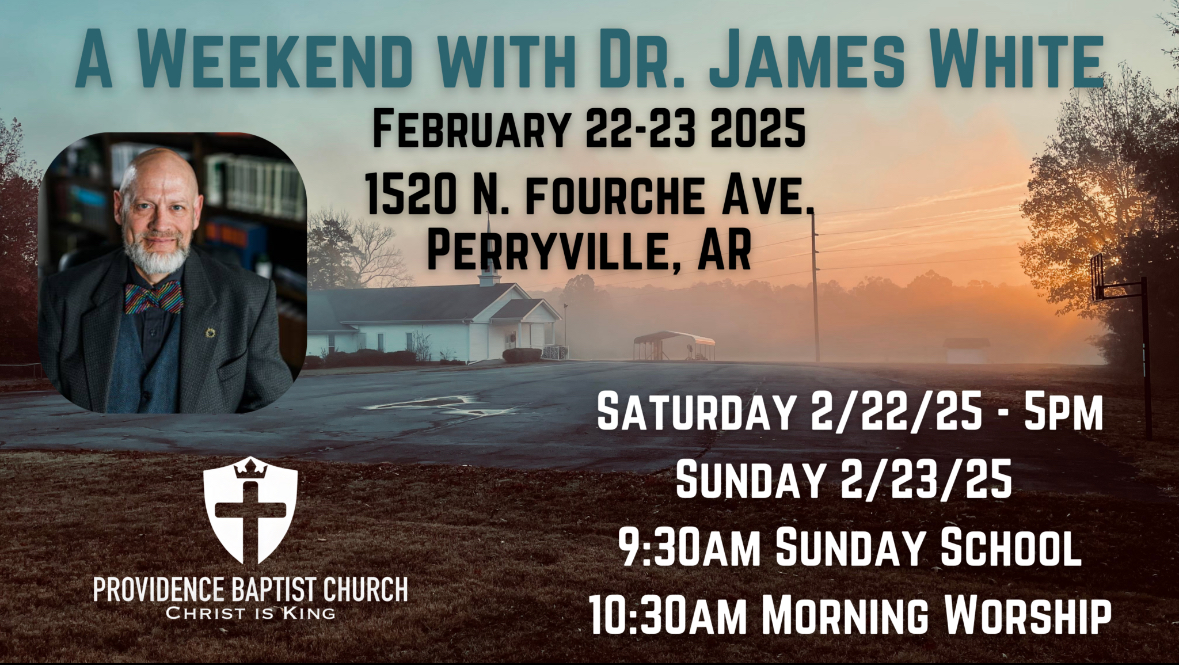
Road Trip: The Importance of a Christian Worldview, Providence Baptist Church, Perryville, Arkansas, 02/22/25
A Sorta-Road Trip Dividing Line from Conway, Arkansas
Drove for eight hours today and arrived safely in Conway, so I got set up and managed to sneak in a quick Dividing Line, discussing upcoming talks, lectures, and debates on this trip, and answering some questions asked on Twitter. Glanced over once and we had over 1,440 people...
Still in Phoenix! Why? Explained. Then: More Developments in Rome
Explained why I am still here in Phoenix when I was supposed to leave today (I leave tomorrow). But mainly we focused on Pope Francis as well as a video clip attacking sola scriptura. If Francis passes, will you be ready to take advantage of all the opportunities to...
About Those “Changes” in the 2025 ESV
Spent most of the hour talking about the edits that went into the 2025 update of the ESV, though that is not the most exciting topic to be addressing! This will be the last “regular” DL for a while as I head out on the road next week, so...
Abolition, Rick Warren, Bill Craig, PWC, Honorius
Late day show today wherein we covered the North Dakota abolition vote, Rick Warren’s horrific eisegesis, Bill Craig on Jesus’ “re-incarnation,” Eric Conn and the PWC, and then to a lengthy discussion of Honorius, Francis, and world’s most useless dogma, “Papal Infallibility.”
Developments in the US, Some Tweets I Forgot Tuesday
Caught a few of the amazing stories coming out about how the left has used the US treasury as their own private slush fund, then moved on to a couple of tweets I forgot to cover Tuesday, one from Stephen Wolfe about a biblical theology of climate change, the...
That Weird Pointy Hat Procession, then, Stephen Wolfe’s Smarter Worldview
Went for a jumbo edition today in the big studio with the big board! Commented briefly about the Roman Catholic penitential procession video that made the rounds a few days ago, then we looked at Stephen Wolfe’s lengthy tweet about the term “worldview” and how we would be better...
Stone Choir Cult Attacks Plus More
Went a full 90 minutes today starting with Corey Mahler and the Stone Choir Cult’s attack on my last evening, followed up by Mahler’s amazing promotion of Marcion’s gnosticism. I used his false statements about the name Yahweh to go into church history and trace the damage that was...
The Post War Consensus then Gold from the Prophet Jeremiah
I was said to be part of the “PWC crowd” in a statement this morning by a young social media type guy, so we looked at what the PWC is, a bit about R.R. Reno, stuff like that, then switched over to Jeremiah chapter ten and some great jewels...
How Denominations Die, How Movements Crash and Burn
Started off with some of the current developments on the world and national stage, then looked at the amazing example of the National Prayer Service yesterday morning in Washington, and the leftist “bishoptrix” at the National Cathedral. How do denominations die? Where do they begin? Then we moved on...
The Andrew Tate Saga Isn’t That Tough, Then, the Alleged Seventh Ecumenical Council (787)
Is Andrew Tate “sinning in the right direction?” I am not even sure what that is supposed to mean, but we spent some time talking about Andrew Tate and the fascinating interaction Christians have been having with him. Then we just about burned the clutch out by shifting over...
A MishMash of Topics Today!
Sometimes you just have a bunch of windows open on the computer and just do your best to work through them! Results in a lot of different topics covered, but hey, that way you might find something that grabs your interest!
Wes Huff on Rogan, Sufficiency of Scripture, Some Calvin Robinson
A number of items on the table today including some words from Mel Gibson about the Pope, a discussion of Wes Huff on Rogan, the sufficiency of Scripture, and some more statements from Calvin Robinson prompting us to again ask Joel Webbon whether he would allow Robinson to commit...
Debating 101
Had so much positive feedback on Twitter when I mentioned possibly doing a program where I just go over debate prep, tools, rules, practice, etc., just had to do it! I didn’t expect it to go nearly two hours, but I guess I should have! Hope you enjoy it!
A Blast from the Past, Marian Devotion, the Book of Abraham
A listener sent in the printed schedule of my events from my trip to New York in April of 1998, which I read through as evidence of the fact that Chris Arnzen tried to kill me back then! After a bit of that we looked at some Marian devotion...
End of Year Catch Up on Developments in the “Trashworld” Controversy
The addition of Catholic speaker Calvin Robinson to the line up at the the Defeating Trashworld Conference in April has stirred up a lot of controversy, and properly so. Stephen Wolfe chimed in today with a tweet about his viewpoint on issues, so we really had to take some...
Pre-Advent Dividing Line
One of the first things I said to Rich when we finished this program was, “How am I going to type THAT ONE up?” and he laughed. So let’s see. Talked about Biden’s disgusting “let’s burn it all down before we leave” campaign of pardons and commutations, Muslim hatred,...
Listen on the Go
Theology Matters
Run From Andrew Tate
I confess, this entire issue leaves me astonished. Sure, it is part of judgment, yes, our hands are covered with blood, so yes, the Lord is just to turn us upon ourselves. I get all of that. “We need examples of masculinity” is all I hear. Look, the family,...
The Sin of Worry
Anxiety. Worry. I will confess, it is a besetting sin. I am not sure why. Maybe I picked it up from my parents, not because they expressed it to me, but because I was astute enough to recognize how difficult their lives were. How little we had, and how...
The Gracious Lens of Romans 1
One of the strongest arguments I know for the inspiration of Scripture is Romans 1. Why? Because all of mankind in all of his many centuries of writing about himself has never come close to the depth and accuracy of Paul’s diagnosis of man, the creature, in rebellion against...
On Presidential Immunity and the SCOTUS
Rational people had come to the same conclusion SCOTUS did on the topic of Presidential immunity for, well, as long as the republic has existed. You cannot have a functioning Presidency if the President can be imprisoned after his term for doing what he had to do as President....
1946 Movie Producers Doing a Road Trip
So I just got an email from the promoters of the 1946 Movie—the film that has face-planted, badly, since its “release” months ago. For some reason, its producers have kept it next to impossible to actually see, and, having seen it myself, I know why (it’s horrible). They are...
On the “Socinian Method”
Well, I guess there has been some progress. At least now I know that yes, brother Briggs was making reference to me, hence, I am a dangerous man to be warned about globally, evidently. I doubt I will get much in the way of serious response about the allegation...
On the Decree and the Actions of God’s Elect
You can tell when certain folks have just completely run out of meaningful commentary and argumentation, or, never possessed any to begin with. When people argue that someone who accepts the biblical teaching of God’s sovereign decree, election, the perfection of the atonement, etc., should, as a result, not...
About that 70 Million Number on Twitter
Well, I should probably just get on my bike and let this whole thing blow over, but, I really can’t. There are some important points that, as is normally the case, are being lost in the fog of battle. Maybe someday someone will go, “Hey, there were some folks...
The Gospel At War Conference Schedule
The More Things Change…
the more they stay the same. That’s the old adage. And in a sense, it is quite true. Recently the topic of Roman Catholicism has been front and center on Twitter. Taylor Marshall, a convert to Roman Catholicism (of some sort, anyway, though surely not the same sort as...
Witnessing Resources
The Mormon Law of Eternal Progression
I spoke on the topic of the “eternal law of progression” in Mormonism in Anchorage this morning. Here is the video.
The 1914 Chronology of Jehovah’s Witnesses
A. Establishing an Ancient Date 1. Fixed Dates 2. King List 3. Cuneiform Tablets 4. Correlation B. Astronomical Data 1. VAT 4956 – astronomical observations made during Nebuchadnezzar’ s 37th regnal year – 568/67 B. C. Hence, his first regnal year was spring 604 B. C., or, using Babylonian...
A Test for the Aaronic Priest
Are you an Aaronic priest? Possibly you are a Latter- day Saint who believes the priesthood was restored by Joseph Smith in 1829 and that you have been ordained as an Aaronic priest. Possibly you believe that Hebrews 5:4 applies to you: “And no man taketh this honor unto...
Latest Debates
Does God Forgive the Unrepentant? – The Dubious Textual Variant, ‘Father, forgive them, for they do not know what they are doing’
A few years back I posted an article explaining the weak textual evidence of Luke 23:34a, “Father, forgive them, for they do not know what they are doing.” This week is Good Friday and many sermons will be using this verse, so I think it is appropriate to bring...
Confucianism, Islam, and Christianity – One Point of Contrast
Qin Shi Huang (260 – 210 BC) is the most prominent of the Chinese emperors. He united China through conquest, began the Great Wall of China, and had the Terra Cotta warriors built. He’s significant to Confucianism – and especially the textual transmission of Confucius’ works – because toward...
Chris Pinto vs. James White – Debate Summarized
The Chris Pinto vs. James White debate on whether Codex Sinaiticus is a modern forgery can be boiled down to a few considerations. 1) Constantine Simonides claimed that he wrote the document based on collating pre-existing manuscripts, and that his uncle corrected the document. Both sides agree that he...
Sola Scriptura
Road Trip: Sola Scriptura – Session 5, Covenant of Grace Reformed Church, St Charles, Missouri, 12/3/23
Road Trip: Sola Scriptura – Session 4 of 4, Covenant of Grace Reformed Church, St Charles, Missouri, 12/2/23
Road Trip: Sola Scriptura – Session 3 of 4, Covenant of Grace Reformed Church, St Charles, Missouri, 12/2/23
Christian Worldview
Road Trip Dividing Line: Jeff Durbin and the Jewish Representative, then Jay Dyer on Abraham
Rich worked hard to work on the audio challenges we have had in the past and the changes made it a lot easier for me to play video clips on the program today. So, we looked at Jeff Durbin’s exchange with the Jewish representative in Georgia, and responded to...
A Divided Nation Then Thoughts on Ecumenical Councils
Reflected on the deep division that exists in Western Culture today and in the United States in particular, and then moved on to some of the Jay Dyer stuff and the continued need to have an in-depth discussion on the “7th Ecumenical Council,” aka Nicea II.
Back from Arkansas, Heading to Louisiana, Two Debates in April, Debate Comments
Excited to be home, but excited to head out in just a matter of weeks for the “Louisiana Loop” that will take me to southern Louisiana for a debate on April 4th, and then to northern Louisiana for a debate on the 10th. Talked a bit about last weekend’s...
Roman Catholicism
Purgatory: 1 Corinthians 3 and Tim Staples
Don’t hold your breath for the invitation for me to be on Catholic Answers Live to discuss, oh, “Does John 6 Teach the Roman Catholic Doctrine of the Eucharist,” (I’d do it in a heartbeat), but today we had Tim Staples on the program for 90 minutes to debate...
Art Sippo on 1 Corinthians 3 and Purgatory
I noted today another fascinating post from Art Sippo, the Catholic lay apologist (and writer of odd pulp fiction stories). Algo had posted a few quotes that demonstrate, as all rational historians recognize, that dogmas like purgatory developed over time, and hence, are not apostolic in origin. Sippo’s response...
1993 Sola Scriptura Debate Review Begins
We began listening to the 1993 San Diego debate on sola scriptura with Roman Catholic apologist Patrick Madrid today. We will continue this review over the course of the next few programs, with the exception of this Thursday when we will be examining the textual variant at Luke 23:34...
The Papacy
Open Phones Dividing Line Friday
Let’s see what some of the topics were: Sam Gipp and “Antioch manuscripts,” the Church & Culture, Debating the Papacy, Justification and Roman Catholic apologists, how to talk to Christians who have bought into social justice theories, and more!
Called to Cyprian – Responding to Anders’ Historical Error
On Catholic Answers, episode #6796, Dr. David Anders makes it sound as though the issue of supremacy of the Roman bishop came up for the first time in the third century, as though “Pope Stephen” asserted the primacy of the Roman see, and as though the East acquiesced in...
DEBATE UPDATE
The Alpha & Omega Ministries App is now available to download.
Events
April 2025 | ||||||
|---|---|---|---|---|---|---|
| S | M | T | W | T | F | S |
1
|
2
|
3
|
4
|
5
| ||
6
|
7
|
8
|
9
|
10
|
11
|
12
|
13
|
14
|
15
|
16
|
17
|
18
|
19
|
20
|
21
|
22
|
23
|
24
|
25
|
26
|
27
|
28
|
29
|
30
| |||
The Dividing Line
The Dividing Line will be LIVE at 3:00pm EDT
The Dividing Line will be LIVE at 3:00pm EDT https://t.co/C3bklilrNP — Alpha and Omega Ministries (@AominOrg) April 9, 2025
Road Trip Debate: Is the King James Version the Best English Translation of the Bible? Dr. James White vs Dr. Doug Levesque, First Baptist Church, Livingston, Louisiana, 04/04/25
Road Trip Dividing Line: Jeff Durbin and the Jewish Representative, then Jay Dyer on Abraham
Rich worked hard to work on the audio challenges we have had in the past and the changes made it a lot easier for me to play video clips on the program today. So, we looked at Jeff Durbin’s exchange with the Jewish representative in Georgia, and responded to...
Story Time with Uncle Jimmy: The Acts of Paul and Thecla
As promised on today’s program I read through The Acts of Paul and Thecla, commented on the Orthodox veneration of Thecla as a saint and “equal of the Apostles,” and what we can learn about the context of the origination of this apocryphal mythology from the second century. By...
I Told You the Sacralists Were Coming, Didn’t I?
So Joel Webbon dropped a webcast about how the State is to correct the Church, and how this has been normative throughout church history. Well, do forgive me, but I’ve always opposed sacralism, still do, always will, and the errors and holes in the presentation, historically and logically, were...
A Nation Divided, My Irrelevancy, the Finished Atonement
Started off with more evidence of how divided a nation the US is, then moved on to listen to some brief comments from He Who Judges from Afar, and then we moved into some thoughts about the debate with Joe Heschmeyer, specifically on what his point was in emphasizing...
Theology Matters
Run From Andrew Tate
I confess, this entire issue leaves me astonished. Sure, it is part of judgment, yes, our hands are covered with blood, so yes, the Lord is just to turn us upon ourselves. I get all of that. “We need examples of masculinity” is all I hear. Look, the family,...
The Sin of Worry
Anxiety. Worry. I will confess, it is a besetting sin. I am not sure why. Maybe I picked it up from my parents, not because they expressed it to me, but because I was astute enough to recognize how difficult their lives were. How little we had, and how...
The Gracious Lens of Romans 1
One of the strongest arguments I know for the inspiration of Scripture is Romans 1. Why? Because all of mankind in all of his many centuries of writing about himself has never come close to the depth and accuracy of Paul’s diagnosis of man, the creature, in rebellion against...
On Presidential Immunity and the SCOTUS
Rational people had come to the same conclusion SCOTUS did on the topic of Presidential immunity for, well, as long as the republic has existed. You cannot have a functioning Presidency if the President can be imprisoned after his term for doing what he had to do as President....
1946 Movie Producers Doing a Road Trip
So I just got an email from the promoters of the 1946 Movie—the film that has face-planted, badly, since its “release” months ago. For some reason, its producers have kept it next to impossible to actually see, and, having seen it myself, I know why (it’s horrible). They are...
On the “Socinian Method”
Well, I guess there has been some progress. At least now I know that yes, brother Briggs was making reference to me, hence, I am a dangerous man to be warned about globally, evidently. I doubt I will get much in the way of serious response about the allegation...
On the Decree and the Actions of God’s Elect
You can tell when certain folks have just completely run out of meaningful commentary and argumentation, or, never possessed any to begin with. When people argue that someone who accepts the biblical teaching of God’s sovereign decree, election, the perfection of the atonement, etc., should, as a result, not...
About that 70 Million Number on Twitter
Well, I should probably just get on my bike and let this whole thing blow over, but, I really can’t. There are some important points that, as is normally the case, are being lost in the fog of battle. Maybe someday someone will go, “Hey, there were some folks...
The Gospel At War Conference Schedule
The More Things Change…
the more they stay the same. That’s the old adage. And in a sense, it is quite true. Recently the topic of Roman Catholicism has been front and center on Twitter. Taylor Marshall, a convert to Roman Catholicism (of some sort, anyway, though surely not the same sort as...
Witnessing Resources
The Mormon Law of Eternal Progression
I spoke on the topic of the “eternal law of progression” in Mormonism in Anchorage this morning. Here is the video.
The 1914 Chronology of Jehovah’s Witnesses
A. Establishing an Ancient Date 1. Fixed Dates 2. King List 3. Cuneiform Tablets 4. Correlation B. Astronomical Data 1. VAT 4956 – astronomical observations made during Nebuchadnezzar’ s 37th regnal year – 568/67 B. C. Hence, his first regnal year was spring 604 B. C., or, using Babylonian...
A Test for the Aaronic Priest
Are you an Aaronic priest? Possibly you are a Latter- day Saint who believes the priesthood was restored by Joseph Smith in 1829 and that you have been ordained as an Aaronic priest. Possibly you believe that Hebrews 5:4 applies to you: “And no man taketh this honor unto...
Latest Debates
Does God Forgive the Unrepentant? – The Dubious Textual Variant, ‘Father, forgive them, for they do not know what they are doing’
A few years back I posted an article explaining the weak textual evidence of Luke 23:34a, “Father, forgive them, for they do not know what they are doing.” This week is Good Friday and many sermons will be using this verse, so I think it is appropriate to bring...
Confucianism, Islam, and Christianity – One Point of Contrast
Qin Shi Huang (260 – 210 BC) is the most prominent of the Chinese emperors. He united China through conquest, began the Great Wall of China, and had the Terra Cotta warriors built. He’s significant to Confucianism – and especially the textual transmission of Confucius’ works – because toward...
Chris Pinto vs. James White – Debate Summarized
The Chris Pinto vs. James White debate on whether Codex Sinaiticus is a modern forgery can be boiled down to a few considerations. 1) Constantine Simonides claimed that he wrote the document based on collating pre-existing manuscripts, and that his uncle corrected the document. Both sides agree that he...
Sola Scriptura
Road Trip: Sola Scriptura – Session 5, Covenant of Grace Reformed Church, St Charles, Missouri, 12/3/23
Road Trip: Sola Scriptura – Session 4 of 4, Covenant of Grace Reformed Church, St Charles, Missouri, 12/2/23
Road Trip: Sola Scriptura – Session 3 of 4, Covenant of Grace Reformed Church, St Charles, Missouri, 12/2/23
Christian Worldview
Road Trip Dividing Line: Jeff Durbin and the Jewish Representative, then Jay Dyer on Abraham
Rich worked hard to work on the audio challenges we have had in the past and the changes made it a lot easier for me to play video clips on the program today. So, we looked at Jeff Durbin’s exchange with the Jewish representative in Georgia, and responded to...
A Divided Nation Then Thoughts on Ecumenical Councils
Reflected on the deep division that exists in Western Culture today and in the United States in particular, and then moved on to some of the Jay Dyer stuff and the continued need to have an in-depth discussion on the “7th Ecumenical Council,” aka Nicea II.
Back from Arkansas, Heading to Louisiana, Two Debates in April, Debate Comments
Excited to be home, but excited to head out in just a matter of weeks for the “Louisiana Loop” that will take me to southern Louisiana for a debate on April 4th, and then to northern Louisiana for a debate on the 10th. Talked a bit about last weekend’s...
Roman Catholicism
Purgatory: 1 Corinthians 3 and Tim Staples
Don’t hold your breath for the invitation for me to be on Catholic Answers Live to discuss, oh, “Does John 6 Teach the Roman Catholic Doctrine of the Eucharist,” (I’d do it in a heartbeat), but today we had Tim Staples on the program for 90 minutes to debate...
Art Sippo on 1 Corinthians 3 and Purgatory
I noted today another fascinating post from Art Sippo, the Catholic lay apologist (and writer of odd pulp fiction stories). Algo had posted a few quotes that demonstrate, as all rational historians recognize, that dogmas like purgatory developed over time, and hence, are not apostolic in origin. Sippo’s response...
1993 Sola Scriptura Debate Review Begins
We began listening to the 1993 San Diego debate on sola scriptura with Roman Catholic apologist Patrick Madrid today. We will continue this review over the course of the next few programs, with the exception of this Thursday when we will be examining the textual variant at Luke 23:34...
The Papacy
Open Phones Dividing Line Friday
Let’s see what some of the topics were: Sam Gipp and “Antioch manuscripts,” the Church & Culture, Debating the Papacy, Justification and Roman Catholic apologists, how to talk to Christians who have bought into social justice theories, and more!
Called to Cyprian – Responding to Anders’ Historical Error
On Catholic Answers, episode #6796, Dr. David Anders makes it sound as though the issue of supremacy of the Roman bishop came up for the first time in the third century, as though “Pope Stephen” asserted the primacy of the Roman see, and as though the East acquiesced in...
Listen on the Go
The Marian Dogmas
James Cone’s Children, Then In-Depth on the Immaculate Conception
Spent just a few minutes at the start on the video of a black Baptist pastor applying the words of Isaiah 53 to John Lewis, explaining how this is perfectly consistent with Black Liberation Theology as developed by James Cone. Then got into a lengthy church history segment focusing...
The Glorious Logic of Sola Ecclesia
Few topics illustrate the circularity of Roman logic than the Marian dogmas. The more honest Roman Catholic writers admit that when you boil it all down, the Marian dogmas are to be believed because you accept Rome’s authority, nothing more. “We are the true church, we have apostolic authority,...
The Audio for the Marian Dogmas Debate has been Posted
Recorded on May 15, 2017 in London: Do the Catholic Church’s Teachings on Mary Constitute Authentic Christian Doctrine? James White debates Peter D. Williams at the London Oratory in St. Wilfrid’s Hall.
Ahmed Deedat
Refuting the Shallow Arguments of Zakir Naik
As most of you know, Zakir Naik is a wildly popular Islamic speaker in the mode of Ahmed Deedat. Unfortunately, Naik knows better than to debate those who can demonstrate his errors. Which is why he remains so popular, it seems! But he cannot hide his many falsehoods. David...
Zakir Naik Illustrates the Dual Face of Islam When in the Public Square
Very interesting contrast from Zakir Naik’s own mouth (again illustrating why Naik refuses to debate those who could expose his arguments).
Zakir Naik’s Claims on Muhammad in the Bible
Here is my third and final response to Zakir Naik’s appearance on The Deen Show. What I did was take my opening statement from my debate with Shabir Ally on this topic from London in November of last year, along with my comments on Deuteronomy 18:18 from the preceding...
Shabir Ally
Debate: Tawhid or Trinity: Is God One or Three Divine Persons? with Shabir Ally at Georgia Tech, Atlanta, Georgia 11/13/2019
On November 13, 2019, James White debated Shabir Ally at Georgia Tech in Atlanta, GA on the topic Tawhid or Trinity: Is God One or Three Divine Persons?
Response to Dr. Shabir Ally, Part IV (Conclusion)
I hurry to finish my response to the article published by Dr. Shabir Ally shortly after our debate at the University of Pretoria in South Africa in early October. This is the fourth, and thankfully, final portion of my response. Dr. Ally continued: James was clearly in a bind....
Debate: Did the Earliest Followers of Jesus Believe in His Deity? Shabir Ally at University of Pretoria, South Africa 10/8/2013
Islam
Mockery is not a Christian Virtue, then, the Carson/Huff Discussion
Last Road Trip DL for 2024 coming from Holbrook, Arizona this evening. Started off looking at Joel Webbon’s defense both of “anons” and using them to mock people “right off X,” naming Owen Strachan as an example. Then we discussed the encounter between Wes Huff, a Christian scholar and...
Mishnah, Talmud, and the Ugly Rise of Side-B Nazism in 2024
Didn’t pull any punches today, folks. When the Nazis come after you it is time to shoot straight in return. Took on some nasty players today, but had to provide background information on, for example, the origination of the Mishnah, Gemara, and Talmud, etc. Hopefully useful to everyone, and...
A Few Comments on the Lawson Issue, Then More Than an Hour in Response to Sam Costner
Couldn’t avoid a few brief comments on the Steve Lawson issue that came to light today at the start of the program. Then I read through an eleven tweet thread written by Samuel Costner back on 8/31 regarding the Crusaders and my supposedly abandoning the younger generation by refusing...
King James Onlyism
Road Trip DL from Jonesboro
Mainly covered the upcoming debates, how to properly encourage someone interested in pursuing apologetics, foundational issues, etc., and then talked a bit about Gavin Ortlund and his videos, and the recent discussion about the canon of Scripture, the Deuterocanonical books, etc. Not sure about when we will be able...
Road Trip #3: The Sad Situation with Steven Anderson, then, Ammon Hillman Reveals His True Intentions
After a few minutes of the inevitable talk about being on the road, going through a McDonald’s drive-thru looking for Donald Trump, and the current election situation, I commented on the Steven Anderson saga, and then spent the rest of the program talking about the claims Ammon Hillman made...
An Unusual Monday Morning Dividing Line
Covered a wide range today, from insanity in Germany, more and more studies showing the danger of the Covid jabs, the Biden Regime’s war on Christians, a few interesting graphics I’ve run across, to finally in the last half of the program, a brief video from Barth Ehrman showing...
Bible Transmission
Confucianism, Islam, and Christianity – One Point of Contrast
Qin Shi Huang (260 – 210 BC) is the most prominent of the Chinese emperors. He united China through conquest, began the Great Wall of China, and had the Terra Cotta warriors built. He’s significant to Confucianism – and especially the textual transmission of Confucius’ works – because toward...
Atheism
Mockery is not a Christian Virtue, then, the Carson/Huff Discussion
Last Road Trip DL for 2024 coming from Holbrook, Arizona this evening. Started off looking at Joel Webbon’s defense both of “anons” and using them to mock people “right off X,” naming Owen Strachan as an example. Then we discussed the encounter between Wes Huff, a Christian scholar and...
Road Trip #3: The Sad Situation with Steven Anderson, then, Ammon Hillman Reveals His True Intentions
After a few minutes of the inevitable talk about being on the road, going through a McDonald’s drive-thru looking for Donald Trump, and the current election situation, I commented on the Steven Anderson saga, and then spent the rest of the program talking about the claims Ammon Hillman made...
The Changing World of Mormonism, A Few Tweets, 90 Minutes
Spent most of the first hour dealing with the changing world of Mormonism in light of comments from the “Ward Radio Show” and the idea of “religious bigotry” in not accepting Mormonism and its plurality of Gods as a Christian church. Looked at a chart about global fertility rates...